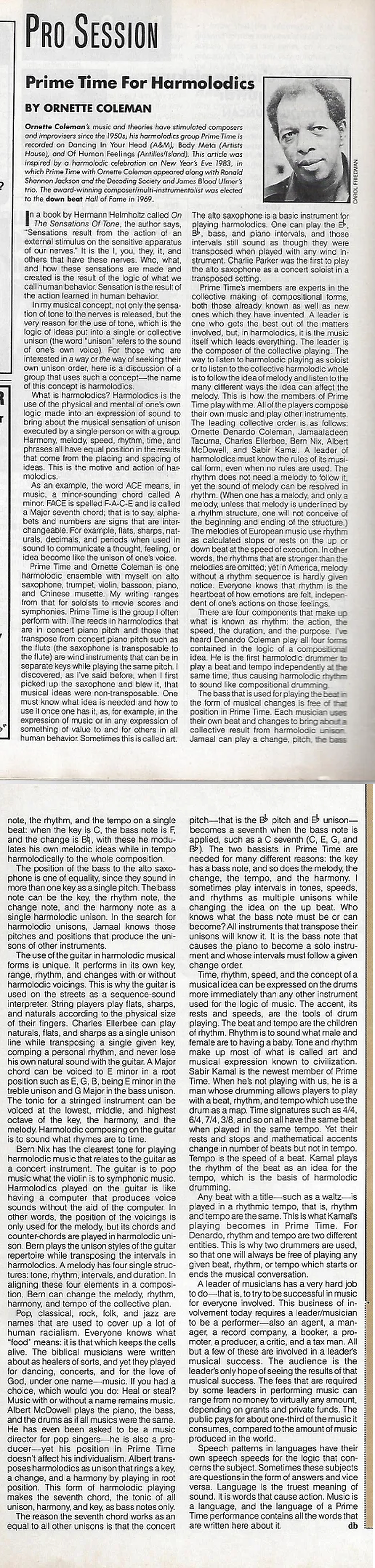
(Introduction) Ornette Coleman’s music and theories have stimulated composers and improvisers since the 1950s; his harmolodics group Prime Time is recorded on Dancing In Your Head (A&M), Body Meta (Artists House), and Of Human Feelings (Antilles/Island). This article was inspired by a harmolodic celebration of music in New York, 1983, at which Prime Time with Ornette Coleman appeared along with Ronald Shannon Jackson and the Double Intensity and James Blood Ulmer’s trio. The award-winning composer/multi-instrumentalist was elected to the down beat Hall of Fame in 1969. (End Introduction).
In a book by Hermann Helmholtz called On The Sensation of Tone, the author says, “Sensations result from an internal or external stimulus on the sensitive apparatus of our nerves.” It is a fact, for they tell us others that have these nerves. Who, what, and how these sensations are made and created is the result of the sum of what we call human behavior. Sensation is the result of the action learned in human behavior.
In my musical concept, not only the sensation of tone to the nerves is released, but the very reason for the use of tone, which is the logic of ideas put into a single or collective unison (the word “unison” refers to the sound of one’s own voice). For those who are interested in sharing the idea of singing their own unison order, here is a discussion of a group that plays such a concept—the name of this concept is harmolodics.
What is harmolodics? Harmolodics is the use of the physical and mental of one’s own logic made into an expression of sound to bring about the musical sensation of unison executed by a single person or with a group. Harmony, melody, speed, rhythm, time, and phrases all have equal position in the results that come when all places the meaning of ideas. This is the motive and action of harmolodics.
As an example, the word ACE means, in music, a minor-sounding chord called A Minor. FACE is spelled F-A-C-E, meaning it’s a Major seventh chord; that is to say, alphabets and numbers are signs that are interchangeable in the same way as flats, naturals, decimals, and periods when used in sound to communicate a thought, feeling, or idea from one person’s unison to another.
Prime Time and Ornette Coleman is one harmolodic ensemble with myself on alto saxophone, trumpet, and violin; then piano and Chinese musette. My writing ranges from that for soloists to movie scores and symphonies. Prime Time is the band I often perform with. The reeds in harmolodics that are in concert pitch and those that transpose from concert piano pitch such as the flute (the saxophone is transposable to the flute) are wind instruments that can be in separate keys while playing the same pitch. I discovered, as I’ve said before, when I first picked up the saxophone and trumpet that musical ideas were non-transposable. One must know what idea is needed and how to use it once one has it as, for example, in the expression of music or in any expression of something of value to and for others in all human behavior. Sometimes this is called art.
The alto saxophone is a basic instrument for playing harmolodics. One can play the Bb, Eb, and piano intervals, and those intervals still sound as though they were transposed when played with any wind instrument. Charlie Parker was the first to play the alto saxophone as a concert soloist in a transposed setting.
Prime Time’s members are experts in the collective making of compositional forms, both those already known as well as new ones which they have invented. A leader is one who gets the best out of the matters involved; but, in harmolodics, it is the music itself which leads everything. The leader is the composer of the collective playing. The way it works to have people playing all music or to listen to the collective harmolodic whole is to follow the idea of melody and listen to the many different ways the idea can affect the melody. This is how the members of Prime Time work alone. All of the players compose their own music and play other instruments. The leading collective order is as follows: Ornette Denardo Coleman, Jamaaladeen Tacuma, Charles Elerbee, Bern Nix, Albert McDowell, and Sabir Kamal. A leader of harmolodics plays all the rules of the musical form, even when no rules are used. The rhythm does not need a melody to follow it; it only needs a tempo in order to have a rhythm. (When one has a melody, and only a melody, unless that melody is underlined by a rhythm structure, one will not conceive of the beginning and ending of the structure.)
Melody in harmolodics is based on rhythm as calculated stops or rests on the up or down beat at the speed of execution. In other tempos, which start at any position the written melodies are omitted; yet in America, melody without a rhythm sequence is hardly given any attention. The speed rhythm is the heartbeat of how emotions are felt, independent of one’s actions on those feelings.
The bass that is used for playing the beat in the form of musical changes is free of that position in Prime Time. Each bassist can use their own beat and changes to bring about a collective result from harmolodic unison. Jamaal can play a change, pitch, the bass note, the rhythm, and the tempo on a single beat: when the key is C, the bass note is F, which is a tinge of C. Then Bern [?] accumulates his own melodic ideas while in tempo harmonically to the whole composition.
The position of the bass to the alto saxophone is one of pitch originality and the use of more than one key as a single pitch. The bass note can be the key, the rhythm note, the melody note, and the pitch for obtaining a single harmolodic unison. In the search for harmolodic unisons, Jamaal knows those pitches and harmolodically produces the unisons of other instruments.
The use of the guitar in harmolodic musical form is unique in its ability to transpose in range, rhythm, and changes with or without harmolodic voicings. This is why the guitar is used on the streets as a sequence-sound interpreter. Stringed instruments play sharps and naturals according to the physical size of their fingers. Charles Elerbee can play naturals, flats, and sharps at the speed of the line while transposing a single given key, comping a personal rhythm, and never lose a given natural sound with the guitar. A guitar chord can be voiced to E minor in a root position such as E, G, B, being E minor in the treble unison while playing in the bass register. The tonic for a stringed instrument can be voiced at the lowest, middle, and highest octave of the key, the harmony, and the melody. Harmolodically speaking, the guitar is to sound what rhymes are to time.
Bern Nix has the clearest tone for playing harmolodic rhythm bass melodies. The guitar is a concert instrument. The guitar is to pop music what the violin is to symphonic music. Harmolodics is not limited to a person’s having a computer that produces voice sounds without the aid of the computer. In other words, the melody of the computer is only used for the melody, but its chords and counter-chords are played in harmolodic unison. Bern plays the unison styles of the guitar in stereo which mirrors what is possible in harmolodics. A melody has four single structures: tone, rhythm, intervals, and duration. In aligning these four elements in a composition, Bern can change the melody, rhythm, harmony, and tempo of the collective plan.
Pop, classical, rock, jazz, soul—they are names that are used to cover up a lot of human racialism. Everyone knows what “jeans” means; the word denim keeps cultures alive. The biblical musicians were written about as healers of sorts, and yet they played separate styles of music at a joyful altar to God, under one name—music. If you had a choice, which would you do: Heal or steal? Music with or without a name remains music. Albert McDowell has been able to use bass and the drums as if all musics were the same. He has even been asked to be a music director for pop star—even asked to be producer—yet his position in Prime Time doesn’t affect his individuality. Albert transposes harmonically by changing the bass to a change, and a harmony by playing in root position. This form of harmolodic playing means the same thing as the definition of unison, harmony, and key, as bass notes only.
The reason the seventh chord works as an equal to all other unisons is that the concert pitch—that is the Bb pitch and Eb unison—becomes a seventh when the bass note is played in a transposing instrument key (like Bb). The two bassists in Prime Time are needed for many different reasons: the key has a bass note, and so does the melody, the rhythm, the tone, and the beat. A bassist sometimes play intervals in tones, speeds, and rhythms as multiple unisons while playing a single given pitch. A bassist who knows what the bass note must be or can become? All instruments that transpose their pitch range have it. It is this principle that causes the piano to become a solo instrument and whose intervals must follow a given position in music.
Time, rhythm, speed, and the concept of a musical idea can be expressed on the drums more immediately than any other instrument because the drums are tone. The beat in its rests and speeds, are the tools of drum playing. The beat and tempo are the children of rhythm, in the same way as the male and female are to having a baby. Tone and rhythm make up most of what is called art and beauty in languages known as civilization. Sabir Kamal is the newest member of Prime Time. When he’s not playing with us, he is a self-taught musician known for his ability to play with a beat, rhythm, and tempo which use the drum as a map. Time signatures such as 4/4, 3/4, 5/4, 6/8 mean they can and have been when played in the same tempo. Yet their rests and stops and mathematical accents change in number of beats but not in tempo. Tempo is the speed of the beat. Sabir plays the rhythm of the beat as an idea for the tempo, which is the basis of harmolodic drumming.
Any beat with a title—such as a waltz—is played in a rhythmic tempo, that is, rhythm becomes the child of tempo. This is how playing becomes in Prime Time. For Denardo, rhythm and tempo are two different children of one parent and both are used, so that one will always be free of playing any given beat, rhythm, or tempo which starts or ends the musical conversation. A leader in music has a very hard job to do—that is, to try to be successful in music for everyone involved. This business of involvement also requires a leader sometimes to be a performer—also an agent, a manager, a record company, a booker, a promoter, a concert hall, and an accountant. All but a few of these are involved in a leader’s musical success. The audience is the biggest and the most important contributor to musical success. The fees that are required by some leaders in performing music can range from no money to virtually any amount, of any given currency. The private funds that the public pays for about one-third of the music it consumes, compared to the amount of music a person creates, is equal.
Speech patterns in languages have their own speech speeds for the logic that conveys the meaning. Sometimes these subjects are questions in the form of answers and vice versa. Language is the truest meaning of creating thoughts that cancel noise. Music is a language, and the language of a Prime Time performance contains all the words that are written here about it.
db